403 Forbidden
ERR_WEB_NGX_403


When replacing an old downlight, the existing ceiling hole may not match the cut-out size specified for your chosen replacement. Different models require different hole sizes, particularly when switching brands or replacing a discontinued fitting. So, if your existing hole size is 80mm and the new downlight specifies a 75mm cut-out, can you still use it? The difference is only 2.5mm on each side, and the bezel might cover the opening—but does that affect the fire rating?
To find out, we contacted several leading downlight manufacturers and asked whether a slightly larger ceiling hole affects the fire rating, even when the bezel covers the opening and the spring clips hold the fitting securely. We also checked their guidance on hole converter plates and replacement downlights designed for larger openings. Their responses highlight an important distinction between a downlight fitting neatly into a hole and retaining its stated fire protection.
The cut-out size is the diameter of the opening in the ceiling. The bezel diameter is the overall width of the visible surround, which overlaps the ceiling around that opening. Neither should be confused with the diameter of the lamp or the downlight body.
A wide bezel can hide an oversized hole, but that does not automatically make the installation suitable. The fitting must also sit correctly, its clips must grip sound ceiling material, and the installation must meet the conditions supporting any required fire rating.

It may fit, provided the bezel covers the opening and the spring clips hold it securely against the ceiling. An 80mm hole is only 5mm wider than a 75mm hole—an extra 2.5mm on each side when the fitting is centred—so the finished installation might look perfectly normal.
The important question is whether it retains its fire rating. If the manufacturer specifies a 75mm cut-out with no permitted tolerance, you should not assume the fire rating also applies to an 80mm hole. The bezel hiding the gap does not confirm that the fitting will provide the same protection during a fire.
This does not mean the downlight would necessarily fail in a larger opening. It means that installation falls outside the stated specification, so its fire performance needs confirmation from the manufacturer. There is no universal allowance for a larger hole simply because the downlight fits and covers it.
Cutting a hole for a recessed downlight creates an opening in the ceiling. A fire-rated downlight helps prevent fire spreading through the opening into the space above. To provide its stated level of protection, it must be installed in a suitable ceiling using the manufacturer’s specified hole size.
Many fire-rated downlights use intumescent material, which expands when exposed to heat to help seal the opening. The size of the gap it needs to seal therefore matters.
When we asked Ovia about installing a downlight specified for a 75mm cut-out into a larger hole, its technical team confirmed that this would fall outside the conditions covered by its fire testing. Ovia specifically highlighted the expansion of the intumescent strip as the reason the opening size is important.
Collingwood gave a similar answer: although a downlight may physically fit a larger opening, its stated fire rating would no longer apply if the hole falls outside the specified size or permitted range.
The ceiling construction also matters. Fire-rating evidence relates to particular ceiling types, including the plasterboard thickness, number of layers and joist construction. A fitting’s advertised fire rating should therefore be checked against the ceiling it will be installed in.
In some buildings, particularly commercial premises, a concrete floor above a suspended ceiling provides the required fire separation. The downlights in the ceiling below may therefore not need to be fire-rated, although the installer should confirm this for the particular building. This is why commercial downlights aren't fire rated.
Not every fire-rated downlight requires one exact hole diameter. For example, the Collingwood H2 Lite CSP has a specified cut-out permitted range of 68–72mm. This gives some installation flexibility, but it does not extend to a 75mm or 80mm hole.
Always use the range stated for the exact model. A tolerance allowed for one downlight cannot be transferred to another, even when the fittings look similar.
Some downlights have a wider cut out size such as the Nova Prismal Maxi 105 Fixed Baffle Downlight with a cut out size ranging from: 60mm to 95mm. This covers many of the tricky downlight hole sizes that we get asked about.
Some do, and some do not. Converter plates and concealer rings can allow smaller fittings to cover larger openings, but their appearance, price and compatibility do not establish their fire performance.
Where fire protection is required, choose a combination with supporting evidence for the specific downlight, accessory, opening and ceiling construction. A fire-rated downlight does not automatically make an otherwise unapproved converter arrangement fire-rated. The IP rating should also be considered, if you've got an IP65 downlight and a non IP rated hole converter plate, water could leak into the fitting.
Collingwood offers two useful options for covering larger openings:
| Accessory | Overall diameter | Ceiling hole range | Fire-rating position |
|---|---|---|---|
| DLCVT110 converter plate | 110mm | 72–95mm | Does not maintain the downlight's fire rating |
| DLCONVERT70 large converter plate | 170mm | 70–150mm | Does not maintain the downlight's fire rating |
The 110mm version provides a smaller, more discreet surround and uses the downlight's original spring clips. The 170mm plate accommodates much larger openings. Collingwood has confirmed to us that its converter plates are not fire-rated. They should therefore not be selected as a way of retaining the downlight's fire rating in an oversized opening. These converter plates are quite expensive, costing more than the downlights that they're used with.
For an existing cut-out between 110mm and 115mm, Collingwood suggested the H5 500 as a potentially suitable fire-rated alternative, subject to the installation requirements. This is quite an expensive option though, at almost 10 times the price of alternative options.
The JCC JC1003 converter plate is a fire-rated conversion option for the compatible standard fixed V50 downlight. It accommodates ceiling openings of 80–120mm and has an overall diameter of 170mm. JCC publishes supporting fire-test information; check the applicable ceiling construction and installation details. Having a 170mm diameter fitting in your ceiling is unsightly though and wouldn't be the ideal option. This is twice as large as most downlights, at this size you might want to consider re-plastering the ceiling and starting from scratch.
This is different from the JCC JC1005 concealer ring, which covers openings of 72–105mm with a 115.3mm diameter. JCC explicitly states that this ring does not maintain the fire rating. It should not be treated as a smaller equivalent of the fire-rated converter plate.
Another option is a complete downlight designed for a wider cut-out range. The JCC V50 Pro Retrofit range offers three useful sizes:
| Downlight | Overall diameter | Specified cut-out range |
|---|---|---|
| V50 Pro 100mm | 100mm | 70–92mm |
| V50 Pro 135mm | 135mm | 70–127mm |
| V50 Pro 170mm | 170mm | 70–159mm |
The size in the product name is the overall diameter, not the hole size. These are fire-rated retrofit fittings, subject to their specified ceiling applications. They provide alternatives to pairing a standard downlight with a separate converter plate. This is a great choice at a reasonable price for larger downlight hole sizes.
Older JCC Flameguard fittings add another complication: some models specified different hole sizes depending on the ceiling construction. JCC's 2015 brochure gives the following dimensions for the versions shown:
| Older model | 12.5mm-thick, 30-minute ceiling construction | 30mm-thick, 60–90-minute ceiling construction |
|---|---|---|
| FGLED3 | 72–74mm | 79–81mm |
| FGLED6 fixed | 71–73mm | 76–80mm |
| FGLED10 | 71–73mm | 80mm |
These are historical specifications for particular versions, not a universal guide to every FGLED fitting. Ceiling thickness alone also does not establish a ceiling's fire resistance.
This was quite a confusing system and was only used with this specific range, this variation makes specifying replacements more difficult. Knowing that the old fitting is an FGLED6 does not tell you whether the opening is around 72mm or 80mm. Measure the actual ceiling hole before choosing a replacement. A modern fitting described as a replacement still needs to suit that opening and the required fire performance. With the newer JCC downlight models of the V50 and X50 having hole sizes of 70mm and 68-70mm. In some instances you'd need to use the hole concealer ring, fit the V50 Pro 100mm or use an alternative brand.

Read more in our JCC Flameguard downlight replacement guide.
If you prefer a fitting with a replaceable LED lamp, the Integral EvoFire range offers several sizes:
| Option | Specified cut-out | What to know |
|---|---|---|
| EvoFire Mini | 43mm | The linked Mini has a 55mm bezel and takes smaller MR11 GU10 LED lamps. |
| Standard EvoFire | 70mm | For standard-size 50mm GU10 LED lamps. |
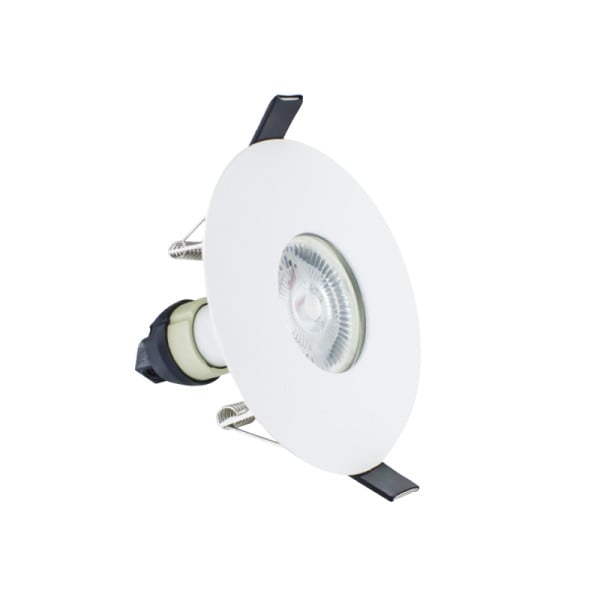
| Large-hole EvoFire | 70–100mm | A wider surround accommodates larger existing openings. |
| Dedicated EvoFire converter plate | 70–100mm | Used with the compatible standard EvoFire fitting, which is purchased separately. |
The dedicated EvoFire converter provides a fire-rated conversion option when used with the specified compatible fitting and installed in accordance with Integral's instructions. It is not a universal fire-rated adapter for unrelated downlights. The larger hole size EvoFire is essentially the standard EvoFire with a hole converter attached to it, but looks much neater. This is a great, affordable and neat option for larger hole sizes. Integral also have a corresponding wider adjustable EvoFire downlight which is suitable for the same 70-100mm hole sizes.

Do not assume that ordinary filler around the fitting or an unverified cover restores fire resistance. If the instructions are unclear, ask the manufacturer whether the exact fitting retains its stated fire performance at your measured hole size and in your ceiling type.
It needs to match the manufacturer's specified size or permitted range for the installation. Some downlights allow several millimetres of variation, and purpose-designed retrofit products can accommodate much wider ranges. Others have a single specified cut-out.
A bezel that hides the hole is only part of the answer. Choosing a fitting or approved converter plate arrangement that suits the measured opening allows you to achieve a neat finish with the required fire protection.